Milos is the island that doesn’t look like it should exist. Smooth white rock at Sarakiniko that seems shipped in from the moon. Sea caves at Kleftiko where pirates once hid. Fishing houses painted red, blue and yellow, moored like boats themselves along the water’s edge.
All of it comes from geology. Milos is a collapsed volcano, and its flooded crater forms the Bay of Milos — one of the largest natural harbours in the Mediterranean. The same volcanic ground gave the island its obsidian, traded across the Aegean since the Stone Age, and the minerals still quarried today.
It is also the island where the Venus de Milo was found in 1820, now in the Louvre, with a cast waiting in the little museum in Plaka.
For sailors, Milos is a highlight of any Cyclades route: a protected harbour the size of a small sea, world-class swimming stops, and the uninhabited island of Polyaigos next door with some of the clearest water in Greece.
This guide covers what to see, what to do, the best beaches and swim stops, where to eat, and everything you need to plan a visit by boat.
Why visit Milos?
Start with variety. Milos is the fifth-largest island in the Cyclades, with around 140 kilometres of coastline and more than seventy beaches — no two alike. White volcanic rock, red and ochre cliffs, warm springs bubbling through the sand, hidden coves with no road at all.
Then history. Obsidian from Milos travelled the Aegean nine thousand years ago; the prehistoric town of Filakopi was one of the most important settlements of its day; early Christians carved extraordinary catacombs into the rock; and a farmer ploughing his field in 1820 found one of the most famous sculptures on Earth.
And yet the island still feels local. Adamas, the port, is a working town. Plaka, the capital, is a real village with real neighbours. The food is island cooking, not resort cooking.
Few Greek islands pack this much into a single stop — and almost none of it can be seen properly without a boat.
What to see in Milos
Sarakiniko, the lunar beach

Sarakiniko is Milos’ signature landscape: a shelf of white volcanic rock weathered into smooth waves, hollows and gullies that slide straight into deep blue water. There is almost no sand and no shade at all — the white stone throws the heat back at you by mid-morning.
Come early. At sunrise you will share the place with a few photographers and the sound of the sea; by ten, with everyone else. Walk the full extent of the rocks, find the small cave beach, and swim from the smooth ledges whenever the sea is calm.
Plaka, the capital on the hill

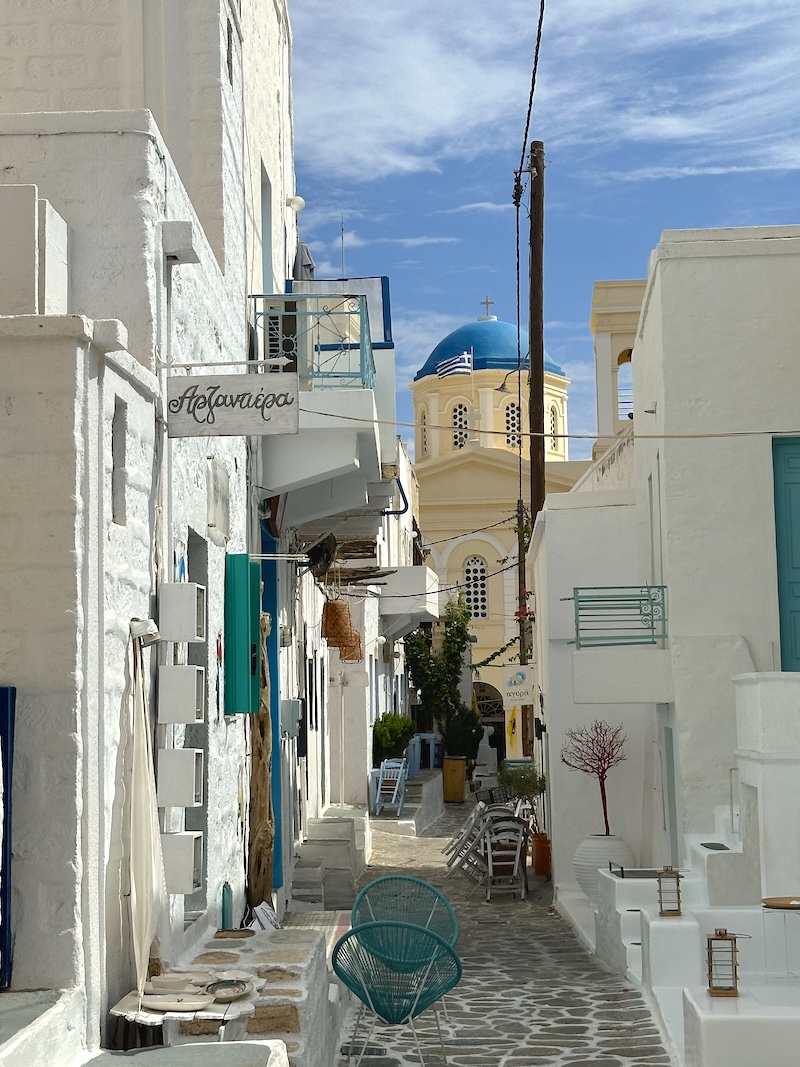
Plaka is everything Milos’ industrial corners are not: a whitewashed hilltop village of car-free lanes, bougainvillea, small tavernas and churches, crowned by the ruins of a 13th-century Venetian castle.
Walk up through the old town to the Kastro at sunset. The view runs across the whole western side of the island and out to sea — arguably the best sunset in the Cyclades, and far calmer than the equivalent scene on Santorini.
Below, the Archaeological Museum holds a plaster cast of the Venus de Milo and tells the story of her discovery.
Trypiti, the catacombs and the Venus find spot
Just below Plaka, the village of Trypiti guards the island’s deepest history.
The Catacombs of Milos, carved from the 1st century AD, are among the most important early Christian monuments in Greece — long galleries of tombs cut into the volcanic rock, believed to hold thousands of burials. Visits run with a guide and close mid-afternoon, so build them into your day.
A short walk away stands the partially restored ancient theatre, with the sea framed between its marble seats, and the field where the Venus de Milo was found — marked today by a simple replica. Trypiti’s restored windmills on the ridge above complete the picture.
The syrmata fishing villages

Milos’ most photographed buildings are not churches or windmills but boathouses. The syrmata are two-storey fishermen’s houses built right on the water, with a garage for the winter’s boat below and living space above. Families painted the doors bright colours so they could spot their home from the sea.
Klima, just below Trypiti, is the famous row — red, yellow and blue doors reflected in still water, best at golden hour. Some now rent as guesthouses.
Firopotamos, further east on the north coast, adds a tiny beach, a whitewashed church on the headland and the same glowing colours; Mandrakia and Fourkovouni are smaller still. Each takes half an hour to wander and none should be missed.

Papafragas, Filakopi and the northeast
Near Pollonia in the island’s northeast corner, Papafragas is a narrow cleft in the white rock where a natural channel leads into an enclosed swimming pool between cliffs — one of the most memorable swims in Greece.
Above it sit the remains of Filakopi, a prehistoric settlement occupied from the 3rd millennium BC, when Milos’ obsidian made it one of the most important islands in the Aegean. And just offshore, the Glaronisia islets rise in hexagonal basalt columns, best seen from the water.
Adamas and the Mining Museum

Adamas is the port and practical heart of the island: a broad horseshoe waterfront of cafés, bakeries, tavernas and tour boats inside the huge natural bay.
The small Mining Museum tells the island’s other story — obsidian, sulfur, bentonite and kaolin dug from these hills for millennia, shaping both the landscape and the striking colours of the coast. It gives everything you see from the boat a second layer of meaning.
What to do in Milos
Swim the wild side of Sarakiniko

Beyond the postcard view, Sarakiniko is a place to move: leap from the smooth ledges into deep water, explore the small sea cave, and watch the white rock glow pink as the sun drops. Only swim when the north wind is quiet — in a meltemi the coast turns rough fast.
Walk down from Plaka to Klima
The path from Plaka through Trypiti and down to Klima takes about half an hour, passing the catacombs and the ancient theatre on the way. It is the most satisfying single walk on the island — history on the way down, colour at the bottom. The climb back up earns your dinner.
Chase the south coast by car or ATV
Rent wheels in Adamas and spend a day on the southern shore: Tsigrado reached by rope and ladder through a crack in the cliff, Firiplaka spread beneath striped volcanic cliffs, and Paleochori where hot springs warm the sand underfoot. The south coast stays swimmable when the meltemi has ruined the north.
Take a day for Kimolos
The little ferry from Pollonia crosses to Kimolos in under half an hour. Walk up to Chorio, the island’s hillside village, swim at the white-sand shallows of Prassa, and eat a long lunch — then decide you should have stayed the night.
Beaches and swim stops in Milos
More than seventy beaches, each with its own geology and mood. These are the ones worth planning around.

Sarakiniko
The white moonscape on the north coast. Not a sand beach but an experience — swim from the rock ledges in calm weather, early or late.
Firiplaka and Tsigrado
The south coast pair. Firiplaka is the island’s best proper beach day: golden sand, shallow turquoise water and cliffs striped orange and pink. Tsigrado next door hides behind a rope-ladder descent — half the fun is getting there.
Paleochori and Agia Kyriaki
Volcanic beaches where warm springs heat the sand in places, with tavernas right on the shore. The most comfortable swimming when the meltemi blows.
Provatas
A double-headed sandy bay in the middle of the south coast — easy, family-friendly and calm through the summer winds.
Firopotamos, Plathiena and Alogomandra
Small northern coves that stay snug in settled weather or a southerly, and shut down completely in a meltemi. Lovely combined with the fishing villages.
Kleftiko, Gerakas and the west
The entire western half of the island has no villages, no sealed roads and a Natura 2000 designation. Its beaches — including the white-sand cove of Gerakas — belong to the boats.
Food and where to eat in Milos
Milos eats like a Greek island rather than a resort. The volcanic soil makes the tomatoes taste saltier, the island’s xinotyro cheese sharpens everything it touches, and the fishing boats still land the day’s catch at Pollonia and the little harbours.
The dishes to hunt for: karpouzopita, the surprising summer specialty of watermelon baked with honey and sesame between layers of thin pastry — look for it in Adamas bakeries in high summer. Pitarakia, small cheese pies filled with xinotyro and mint. Ladenia, the island’s tomato-and-onion flatbread, best warm from the oven. Gouna, fish dried in the sun and then grilled. And in season, astakomakaronada — lobster pasta.
O Hamos, near Adamas
O Hamos at Papikinou beach is the name every local gives you. A family taverna with its own farm — the cheese and meat on the handwritten menu come from the owners’ own sheep and goats. Order the pitarakia, the black-eyed pea salad and whatever they cooked that day. Walk-in only; arrive early and wait with a drink by the beach.
Medusa, Mandrakia

Perched above the tiny painted harbour of Mandrakia, Medusa serves the island’s best-loved seafood lunch — octopus, fresh fish and simple meze with the boats bobbing below. Come by road or by tender; either way, book ahead in August.
Pollonia waterfront
The island’s best dinner scene lines the sandy waterfront at Pollonia, where the boats land their catch each morning. Armenaki is the stand-out fish taverna — lobster linguine, fried cuttlefish with rosemary, and seafood few other tables in the Cyclades can match. Beachfront restaurants such as Akrotiri and Nama plate traditional dishes with your feet almost in the sand.
Beach tavernas at Paliochori
At Paliochori, tavernas such as Sirocco set their tables on the volcanic beach where hot springs warm the ground — and cook some dishes in it. Grilled fish, cold wine and steam rising from the sand is a very Milos way to spend an afternoon.
Exploring Milos by boat
Milos is one of the great sailing destinations of the Aegean. The flooded volcanic caldera gives the Bay of Milos extraordinary scale and shelter, while the rest of the coast delivers the swimming stops people charter boats for.
Adamas, the main port
Adamas sits at the head of the bay and is the island’s only true harbour. Visiting yachts berth bow- or stern-to the yacht quay and the excursion-boat mole — room for a few dozen vessels — with water and electricity on the quay and fuel arranged by delivery. The bay’s mud and weed bottom holds well for anchoring off, clear of the ferry lane.
Shelter from the summer meltemi is excellent; strong southerlies and westerlies are the exception to plan around. Ashore, everything is at hand: provisioning, repairs, tavernas and the boat-tour fleet.
Kleftiko and the southwest coast

Kleftiko is the crown jewel: towering white rock pillars, arches and sea caves on the otherwise roadless southwest coast, once a pirates’ hideout. It can only be reached by water.
Arrive early, before the tour boats from Adamas, and anchor on the sand patches in 10–15 metres with lines ashore where offered. Swim into the caves by tender or mask, and give Sykia — the collapsed cave with an open roof, a little further along the coast — its own stop. Kleftiko is exposed to the south, so treat it as a calm-weather day stop rather than an overnight berth.
Polyaigos and the Blue Lagoon

East of Milos lies Polyaigos, the largest uninhabited island in the Cyclades — wild, goat-covered and surrounded by water of an unreal blue. The bays on its west side, around the islet of Manolonisi and the Mersini area, offer shallow turquoise anchoring over white sand that sailors rank among the best in Greece.
The island is a refuge for the Mediterranean monk seal; give the coast respect and the quiet will give you back everything.
Kimolos
The strait between Milos and Kimolos is short but genuinely tricky, with reefs and shoals that deserve a careful chart. Kimolos itself rewards the effort: the port of Psathi offers good shelter and a modern quay, the anchorage off the Prasonisi islet is a favourite, and the village of Chorio uphill is one of the most authentic in the Cyclades.
The south coast and the bay
When the meltemi rules the north, the south coast is the plan: Provatas offers roomy anchoring in 3–7 metres on sand, well protected from northerlies, and the Tsigrado coves east of Cape Zefyros do the same in more dramatic scenery. Inside the great bay itself, alternatives such as Achivadolimni and Fatoúrena give the crew options in almost any wind.
Cruising tips
Distances from Adamas flatter every itinerary: Kimolos 13 miles, Sifnos 24, Serifos 30 and Folegandros 35. A full loop of Milos, Polyaigos and Kimolos fits easily into a week and is one of the most rewarding short cruises in Greece.
The meltemi blows hardest in July and August; the bay gives you shelter while the open Aegean whitens. Southerlies are rarer but stronger, and they cancel the Kleftiko day — keep a south-coast beach plan as backup. Turbulence around the island’s headlands produces strange local gusts, and the Kimolos strait demands current charts.
For crews who would rather someone else handle the mooring, locally operated sailing trips from Adamas and Pollonia cover Kleftiko, Sykia and Polyaigos daily in season.
Getting around Milos
Buses connect Adamas with Plaka, Trypiti, Pollonia and the main beaches in summer, but the network is built around locals rather than beach days.
For real freedom, rent a car or ATV at the port — the island’s spread-out coastline demands it. Fast ferries reach Milos from Piraeus in three to four hours, and a forty-minute flight connects Athens with the island’s small airport in season.
How many days do you need in Milos?
Two days cover the headlines: Sarakiniko, a boat day to Kleftiko, and a Plaka sunset. Three add both coasts and the villages without panic.
Four to five days is where Milos starts making sense — a spare afternoon for the wind to misbehave, a slow lunch at Mandrakia, a Kimolos hop and a second swim at whichever beach the meltemi spared. On a charter, build that flexibility into the route rather than the schedule.
Islands to visit after Milos
Milos anchors the southwestern Cyclades, and its neighbours are among the finest islands in Greece.
Kimolos, across the strait, is the quiet twin — whitewashed Chorio, white-sand Prassa and taverna cooking that hasn’t changed in decades.
Sifnos, east, is the food pilgrimage: clay-pot revithada, mastelo lamb and hilltop monasteries over the sea.
Serifos, north, pairs a striking hilltop Chora with a wide port bay and quiet beaches.
Folegandros, south, offers a cliff-edge Chora and a compact ferry harbour on the onward route toward Santorini.
And if the calendar allows, Santorini lies southeast — a spectacular land visit best treated as a planned, conditional stop for a boat.
Final thoughts
Milos is the island people underestimate and then rearrange their plans around. The moon-rock at Sarakiniko, the pirates’ caves at Kleftiko, a painted boathouse with a blue door, a warm patch of sea where the volcano still breathes — none of it looks real, all of it is.
Arrive with a boat if you can. The island’s best places were never given roads.
Research sources
Harbour classifications, mooring arrangements and island facts in this guide were cross-checked against the references below.
- Municipal Port Fund of Milos (ELIME) — official port information for Adamas.
- Municipality of Milos — official island information and services.
- Greek National Tourism Organisation — Milos — official destination guide.
- Cruisers Wiki — Milos cruising guide — harbour and anchorage details for visiting yachts.
- Sailing Issues — Milos ports and anchorages — independent sailing notes for the island.
These references support itinerary research but do not replace live navigational information, port notices or your skipper’s judgement.