Kythnos is the island the Athenians kept to themselves. It sits between Kea and Serifos, less than two hours by ferry from Lavrio, yet it has none of the crowds, resorts or yacht marina queues of its more famous neighbours.
Instead, it offers something rarer: natural hot springs that bubble up beside the sea, a double-sided sandbar at Kolona that looks photoshopped even in person, whitewashed villages where locals still outnumber visitors, and around one hundred beaches — more than any other island in the Cyclades.
The island’s old name, Thermia, says a lot. People have come here for the warm mineral springs since antiquity. Everyone else comes for the water, the food and the quiet.
For sailors, Kythnos is almost always on the route: an easy first or last stop out of Athens or Lavrio, with a friendly port, a small harbour by the hot springs and bays that shelter beautifully when the meltemi blows.
This guide covers what to see, what to do, the best beaches and swim stops, where to eat, and everything you need to plan a visit by boat.
Why visit Kythnos?
Kythnos is small — about 99 square kilometres with a coastline of roughly 100 kilometres — and that coastline is wonderfully ragged, folding into coves and bays almost everywhere you look.
Its history goes deep. At Maroulas, near Loutra, archaeologists uncovered one of the oldest settlements in the Aegean, dating to the Mesolithic period around the 9th millennium BC. In antiquity the island mined iron and copper and supplied famous archers to other Greek states.
But the island’s real character comes from what it never became. There is no airport, no cruise port and no large-scale development. The two inland villages, Chora and Dryopida, still look and feel like working communities. Prices are lower than on the headline islands, and the pace is slower.
Add the hot springs, the sandbar and a hundred swimmable coves, and Kythnos becomes one of the most rewarding stops in the western Cyclades.
What to see in Kythnos
Chora, the whitewashed capital

Chora, also called Messaria, is a classic Cycladic capital built inland and out of sight of the sea — pirate-era logic that kept it safe for centuries.
Its lanes are too narrow for cars, painted white with painted details in the old style, and dotted with small squares, café tables and courtyards that smell of jasmine in the evening. The island counts well over a hundred churches and chapels, and Chora holds a good share of them.
Don’t miss the church of Agia Triada, with its carved marble bell tower, or a slow wander down the main alley as the lights come on. Come in the evening, when locals fill the squares and the village feels like a stage set that happens to be real.
Dryopida and Katafyki Cave
Dryopida looks different from every other village in the Cyclades. Instead of flat roofs, its houses carry red terracotta tiles — a local tradition found almost nowhere else in the island group.
The village hides in a valley, deliberately invisible from the sea, and below it lies one of the surprises of the Aegean: Katafyki, one of the largest caves in Greece.
Katafyki served locals as a refuge from pirates — its name comes from the Greek word for shelter — and later worked as an iron mine, with rusted tools still resting where the miners left them. Guided visits run in summer through chambers of stalactites and strange stone landscapes. Bring a light layer; it stays cool inside.
Loutra and the thermal springs

Loutra is the reason the island was once called Thermia. Here, mineral-rich water heated underground flows out of the rocks and runs straight into the sea, creating warm pools where you can soak while waves break a few metres away.
The springs of Agioi Anargyroi and Kakavos have drawn bathers for centuries. In the 19th century, during the reign of King Otto and Queen Amalia, the first hydrotherapy hotel in Greece was built here, and its handsome neoclassical building still stands at the water’s edge. A modern spa operates alongside, and a swim in the free sea-side pools costs nothing.
The water is genuinely hot — far warmer than the sea — so start slow. The village itself is pretty too, with a sandy beach, waterfront tavernas and a small harbour full of fishing boats and visiting yachts.
Vryokastro, the ancient capital
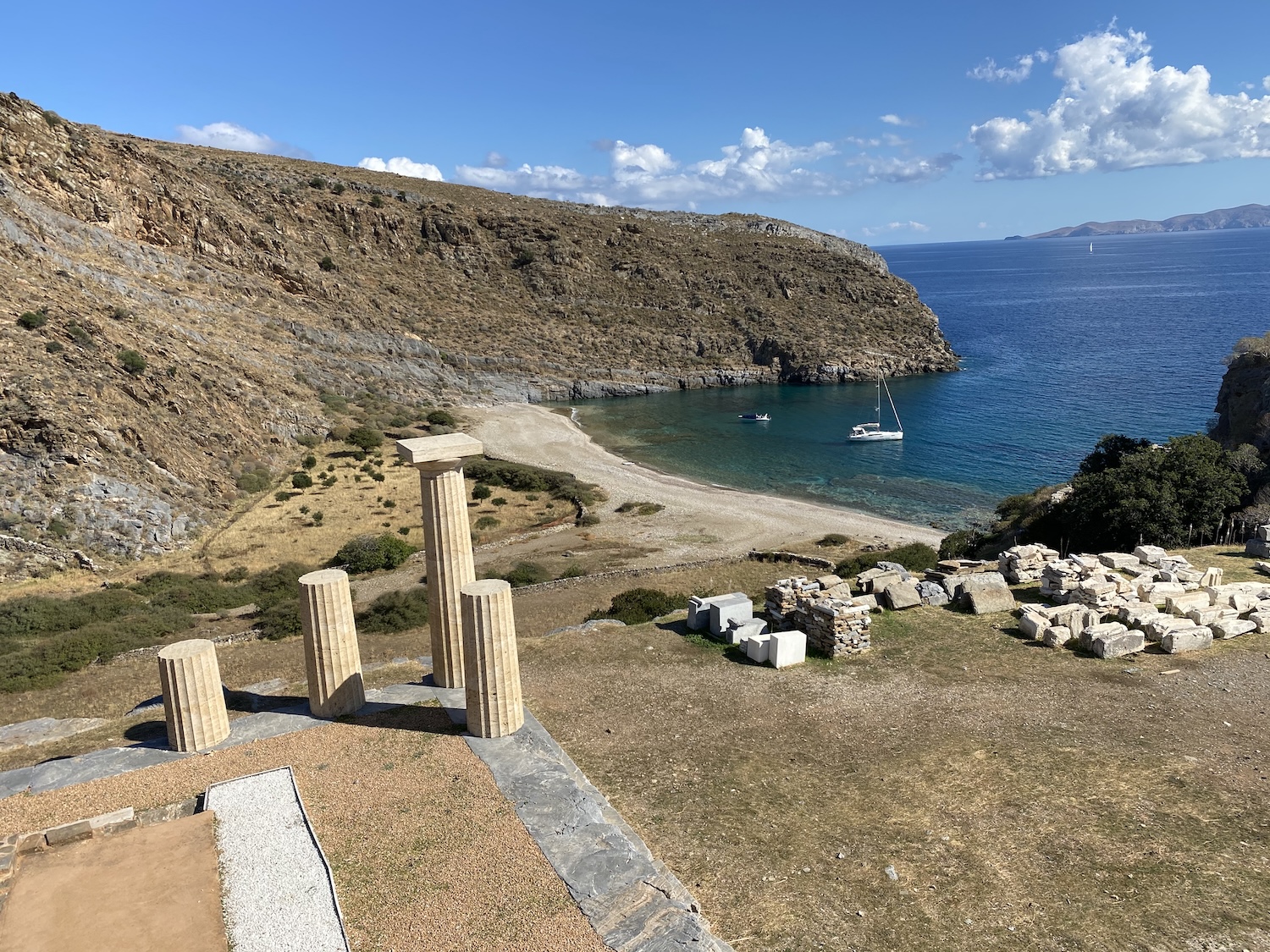
On the northwest coast, on a headland above the bays of Apokrousi and Episkopi, lie the remains of Vryokastro, the island’s ancient capital, inhabited from the 10th century BC to the 7th century AD.
Sanctuaries to Apollo, Artemis, Aphrodite and Demeter once stood here. Today the site is gloriously unrestored — foundations, walls and views, reached on foot along a walking path, with the sea glittering below.
The views from the ridge take in the famous Kolona sandbar, which gives you a good sense of how well the ancients chose their harbours.
Panagia Kanala

On the southeastern coast, the monastery of Panagia Kanala sits in the island’s largest pine grove, just above a quiet sandy bay.
It holds the icon of Panagia Kanala, patron saint of Kythnos, and on 15 August the island gathers here for one of the most heartfelt religious festivals in the Cyclades, with music, dancing and food under the pines.
Even outside festival season, the combination of sea air, pine shade and the little church above the water makes it an easy, lovely stop.
What to do in Kythnos
Swim on both sides of the Kolona sandbar

Kolona is the island’s signature experience: a narrow strip of golden sand connecting Kythnos to the tiny islet of Agios Loukas, with calm sea on both sides at once.
Walk the spit, swim whichever side the wind leaves glassy, and climb the ten-minute path to the chapel on the islet for the classic view back over the two bays. Water taxis run from Merichas in summer in about fifteen minutes, which is how most visitors arrive.
Go early or late. Midday light flattens the colours and, on summer weekends, Athenian boats crowd the anchorage.
Soak in the hot springs
You can bathe at Loutra any time of day, free of charge, in the natural pools where the spring meets the sea — an experience that is genuinely unique in the Cyclades.
Bring water shoes: the rocky bottom can be slippery with mineral deposits. Evening is a wonderful time to go, when the day-trippers have gone and the water steams gently into the dusk.
Hike the island’s footpaths
Kythnos is crossed with old stone paths linking villages, chapels, windmills and beaches, and they are some of the most rewarding in the Cyclades.
A favourite route runs from Chora to Kolona, finishing with panoramic views from the chapel of Agios Loukas — superb at sunset. Another connects Dryopida with the quiet beach of Lefkes, passing the stone plystaria of 1852, where the village women once washed laundry together.
Go early, carry water, and let the island unfold at walking pace.
Snorkel, dive and go fishing
The water around Kythnos is clearer than it has any right to be, with rocky walls, reefs and small caves that make it a favourite of the Athenian diving community. A diving centre at Loutra runs guided dives and courses in summer.
Even with just a mask and fins, the rocky points between beaches reward a slow swim. Ask locally where the octopus hunters work — then order some grilled that evening.
Beaches and swim stops in Kythnos
With around one hundred beaches, Kythnos holds the Cycladic record — and most of them never feel crowded.

Kolona and Apokrousi
The famous sandbar and, just to its east, the broader sandy bay of Apokrousi with golden sand and a small canteen. The walk between the two takes five minutes, and Apokrousi is usually the quieter of the pair.
Episkopi and Martinakia
Two of the west coast’s easiest beaches, with sand, shade and tavernas at the back. Good all-round choices when you want a proper beach afternoon without a dirt road.
Lefkes and Gaidouromantra
Southeast-facing beaches reached by road and loved for their calm, clear water and absence of development — typical of the island’s quieter side.
Loutra
The village beach, where a warm spring stream runs into the sea at one end. A swim here is half beach day, half spa treatment.
Agios Sostis
A secluded sandy beach just behind the hill of Agios Loukas from Kolona, reached on foot or by boat. Quiet, clothing-optional by tradition, and beautifully clear.
Food and where to eat in Kythnos
Kythnian cooking is honest island food: fish caught the same morning, goat and lamb from the hillsides, cheese from small dairies and vegetables from family gardens.
Start with sfougato, the island’s signature fried croquettes made with goat’s-milk cheese, and kolopia, a wild-greens pie with plenty of green onion. Look for stuffed squid, the local seafood specialty, sun-dried fish, strapatsades with courgette, and — if you time it right — rooster cooked in wine, a dish reserved for weddings and good tavernas.
The island’s cheeses deserve attention too: crumbly local trimma, soft kopanisti and classic feta, plus capers, pasteli and almond sweets to take aboard.
Merichas waterfront
The port has the island’s liveliest dining scene, strung along the harbour. Mirra is the all-day favourite, serving brunch through dinner with a menu that puts local ingredients — including Kythnian trima cheese — at the centre.
Traditional tavernas along the quay serve the day’s fish and grilled octopus with their feet planted firmly in island cooking. This is where most crews end up on their first night, and happily so.
Loutra by the springs
After an evening soak, walk straight to one of the small waterfront tavernas for home-style dishes — clay-pot lamb, stuffed tomatoes, whatever fish came in that morning. It is a relaxed, characterful scene, with tables practically on the sand.
Chora, Kanala and the beach tavernas
In Chora, courtyard and alley tavernas serve slow island classics under the jasmine. At Panagia Kanala, a taverna under the pines serves simple grilled food above the bay.
And in classic Kythnos fashion, several of the best meals are at the beach: Episkopi, Martinakia and Apokrousi all have tavernas a few steps from the water, ideal after a swim — or after arriving by tender.
Exploring Kythnos by boat
Kythnos rewards sailors twice: once with the easiest, most reliable logistics in the Cyclades, and once with some of its prettiest anchorages.
The island sits on the western edge of the Aegean wind system, so the summer meltemi usually blows softer here than further east. It lies about 25 miles southeast of Cape Sounion, which makes it the classic first or last night of an Athens-based charter.
Merichas, the main port

Merichas is the ferry port and the island’s main base. Yachts go bow- or stern-to the town quay just south of the short ferry jetty, where depths run 3–5 metres over good sand and mud holding.
Shelter is good in the prevailing northeasterly meltemi, which blows you off the quay, but poor in strong westerlies. Expect a surge when fast ferries dock, and keep lines snug. Ashore you have tavernas, cafés, mini-markets, bakeries and car rental — everything a crew needs within a few minutes’ walk.
Loutra harbour
Loutra, on the northeast coast, is the island’s most yacht-friendly harbour and offers the best meltemi protection on Kythnos. A long breakwater with an L-shaped head shelters a compact basin with room for around a dozen yachts bow- or stern-to, plus a few alongside.
Water and electricity are available on the quay, and the hot springs, beach and tavernas are steps away. Space is tight — prepare lines and fenders before entering — and the outer side of the mole takes some swell in strong northeasterlies.
Kolona, Fikiada and Apokrousi
North of Merichas, in the lee of Cape Kolona and the islet of Agios Loukas, lie two enchanting bays separated by the sandbar: Ormos Kolona and Ormos Fikiada. Both are well protected from the meltemi and from southerlies, and the water is reliably, improbably clear.
Anchor in the bay that suits the wind, or take a long line ashore near the sandbar and enjoy what many sailors call the best swimming pool in the Cyclades. Small weed patches can fool an anchor into appearing set, so check it by snorkeling before you trust it.
A small natural hot spring bubbles into the sea on the north side of Kolona — a sandy bathtub you can lie in while your boat swings at anchor. On summer weekends the bays fill with Athenian motor cruisers, so arrive early or plan an overnight for the quiet hours.
Apokrousi, just east of Fikiada, is another protected cove with room to anchor around four metres — again, mind the weed.
Around the rest of the coast
On the east coast, Agios Stefanos offers good shelter from the meltemi, and the deep inlet at the southeast end of Loutra bay allows anchoring in 3–6 metres with a line ashore. Kanala and Episkopi are pleasant stops in settled weather but open to the southeast.
The northern coast is wilder and exposed — glorious to sail along, best admired from the deck unless the forecast is genuinely calm.
Cruising tips
Distances flatter every plan: Kea eight miles north, Serifos about eighteen miles south, Sifnos and Milos further on down the island chain. However you bend the route, Kythnos sits conveniently at its start.
Time the crossing from Kea or Lavrio for the morning — the channel between Kea and Kythnos funnels the meltemi into a brisk, gusty breeze by afternoon. Gusts also roll off the island’s high ridges, so leave a margin on your anchoring.
Water taxis shuttle between Merichas and Kolona in summer — handy when the crew wants a beach lunch ashore while the boat stays anchored.
Getting around Kythnos
A local bus connects Merichas with Chora, Loutra, Dryopida and Kanala several times a day in summer, but it does not reach most beaches.
Cars and scooters rent at the port, and roads are decent by island standards — you can cross the island in twenty minutes. Taxis exist but are few; book ahead in July and August. Water taxis cover the coastline and are the classic way to reach Kolona.
How many days do you need in Kythnos?
One full day covers the essentials: Kolona in the morning, Chora or Dryopida and Katafyki Cave in the afternoon, and dinner by the water.
Two days let the island breathe. Add the thermal springs at Loutra, a hike, a slow beach lunch at Episkopi or Apokrousi and a second swim at whichever bay the wind spared.
On a crewed charter, Kythnos typically appears as the first or last night of the route — arrive for a late swim at Kolona, spend the evening in Merichas or Loutra, and leave with the springs still warm on your skin.
Islands to visit after Kythnos
Kythnos anchors the northwestern corner of the Cyclades, with excellent onward legs in every direction.
Kea, eight miles north, brings oak-shaded trails, the Lion of Ioulis and a famously sociable little harbour at Vourkari.
Serifos, to the south, adds a striking hilltop Chora above a wide port bay and beaches for every wind.
Sifnos, southeast, is the food pilgrimage: clay-pot revithada, mastelo lamb and monasteries over the sea.
Milos, southwest, is the volcanic showpiece — Sarakiniko, Kleftiko and some of the finest cruising in the Aegean.
Linked together, they form the classic western-Cyclades circuit: short legs, honest harbours and a new character every day.
Final thoughts
Kythnos does not try to impress you. It simply hands you a sandbar with sea on both sides, a hot spring steaming into the waves, a cave beneath a village and a taverna table with the day’s fish on it.
Give it a day or two on your route — ideally at the start, when the crew is fresh and the meltemi is still a rumour — and it will quietly become the island everyone talks about on the flight home.
Research sources
Harbour classifications, mooring arrangements and island facts in this guide were cross-checked against the references below.
- Municipality of Kythnos — official information on the island’s villages, beaches and thermal springs.
- Cyclades Chamber of Commerce — Kythnos island guide — history, sights and ferry connections.
- Greek National Tourism Organisation — Things to do on Kythnos — official destination recommendations.
- Cruisers Wiki — Kythnos cruising guide — harbour and anchorage details for visiting yachts.
These references support itinerary research but do not replace live navigational information, port notices or your skipper’s judgement.