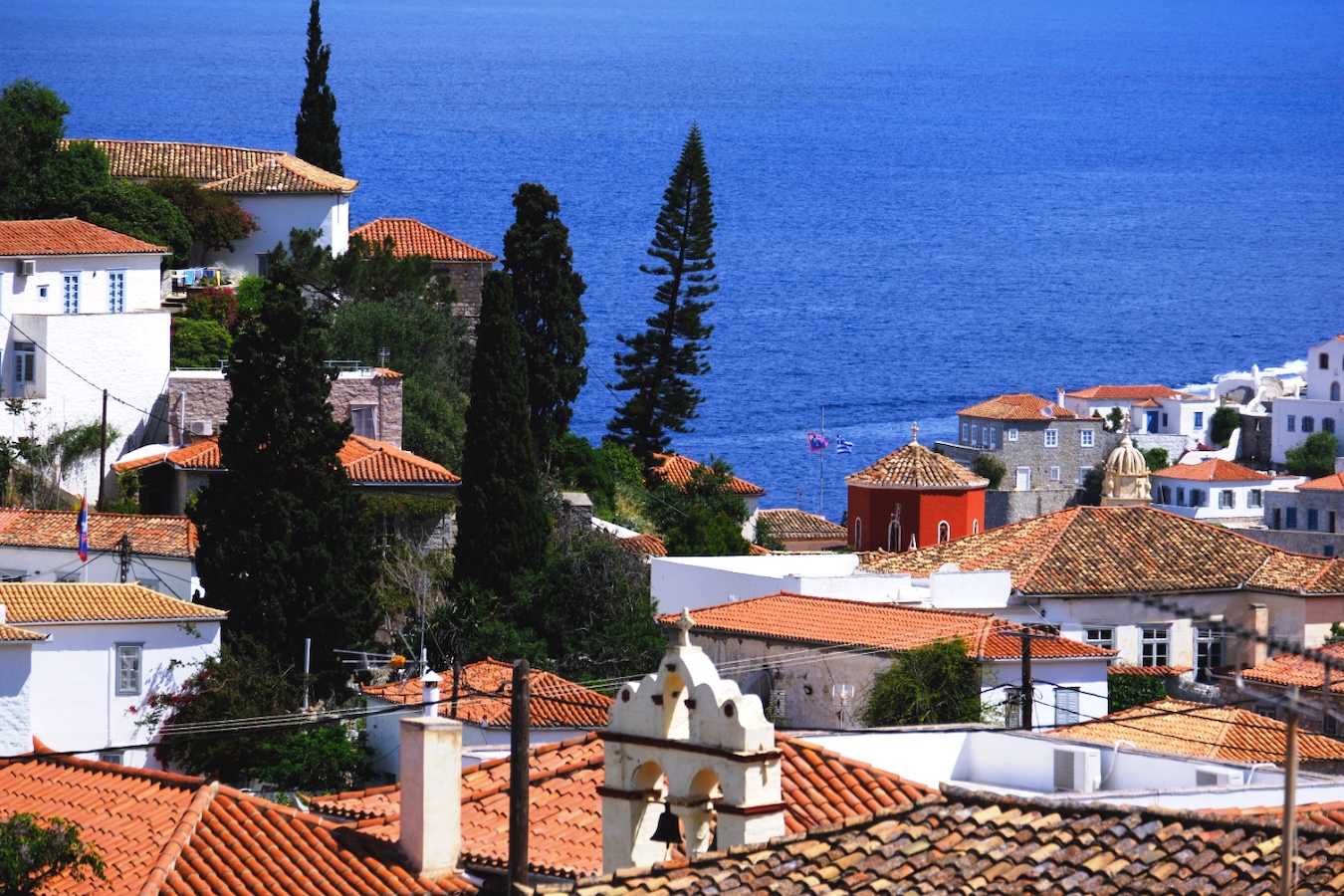
Hydra announces itself from miles offshore: a steep grey amphitheatre of stone mansions rising straight above a perfect horseshoe harbour. It is one of the great arrivals in Greek sailing — and the island behind it more than keeps the promise.
Cars have long been banned here. Everything moves on foot, by donkey or by water taxi, and the absence of engines lends the town an almost theatrical calm: church bells, hoofbeats on stone, conversation and the slap of water against the quay.
The calm sits on a fierce history. Hydra’s merchants built one of the great merchant fleets of the Aegean, and their ships and fortunes powered the Greek War of Independence. The mansions stacked above the harbour were paid for by that trade, and the island later drew painters, writers and film-makers — Sophia Loren shot Boy on a Dolphin here in 1957, and Leonard Cohen bought a house above the harbour in 1960.
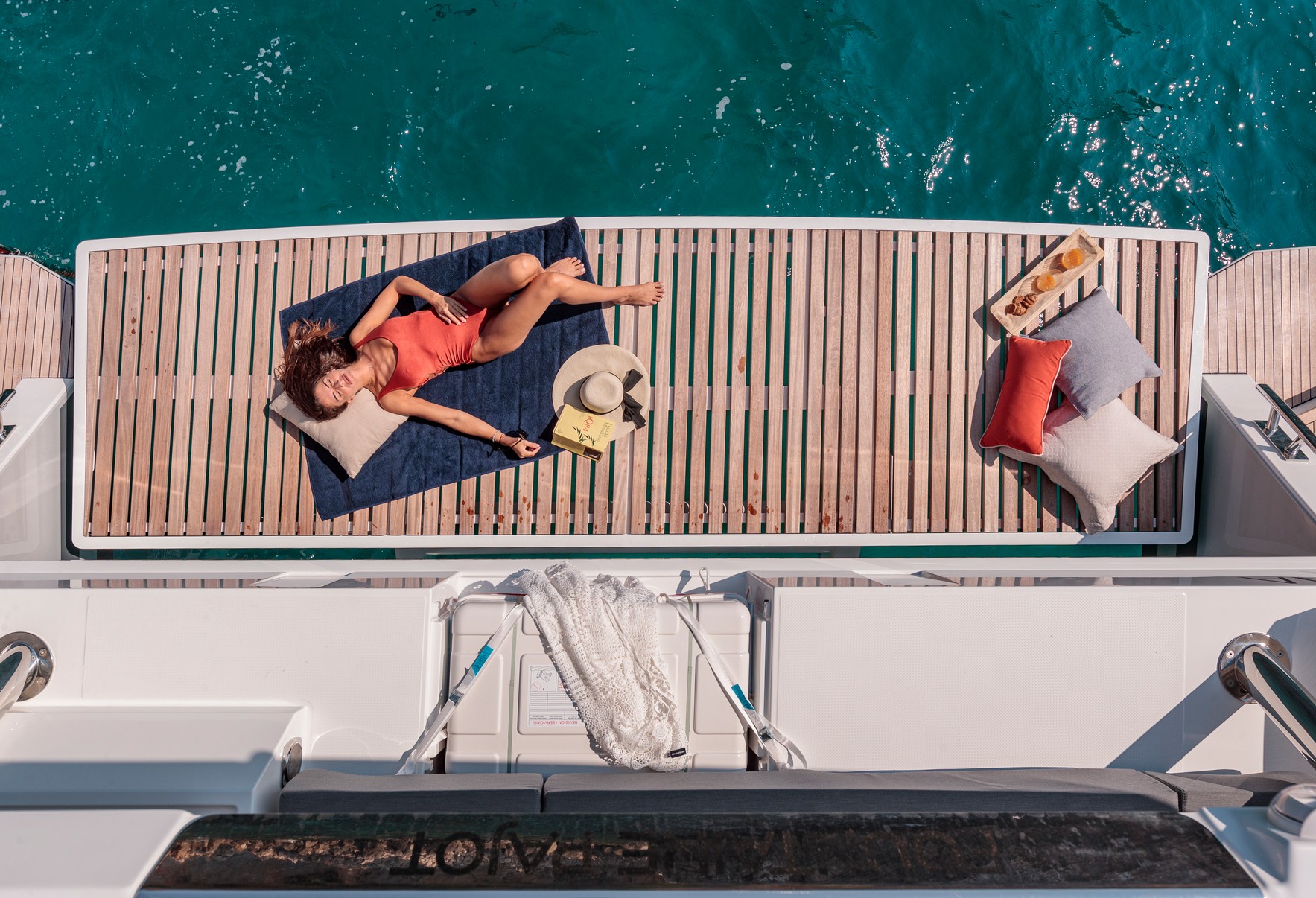
Seen from the deck of a catamaran, Hydra compresses wonderfully: harbour, mansions, monastery-topped hills and swim platforms all within sight of your berth.
This guide covers what to see, what to do, the best beaches and swim stops, where to eat, and everything you need to plan a visit by boat.
Why visit Hydra?
Hydra sits at the eastern end of the Saronic Gulf, a rocky spine climbing to Mount Eros at 588 metres — the highest summit of any Saronic island. The land is barren, which is precisely why the sea made Hydriotes rich: with little to farm, the island poured its energy into shipping and became one of the maritime powers of the nineteenth-century Mediterranean.
Today that inheritance looks effortless. Marble mansions in warm grey stone climb the hillsides in tiers, the harbour curves between two old artillery bastions, and the whole stage set is protected — no vehicles, no cruise-ship chaos, just an island that works beautifully on foot and from the water.
The famous light deserves its reputation. Painters have chased it for a century: sharp at noon, honey-gold at dusk, when the mansions turn amber and swimmers leap from the bastions into deepening blue.
For crews, Hydra is the showpiece night of a Saronic loop. It asks more of the skipper than anywhere else in the gulf — the harbour is small, busy and open to the south — but arrive with a plan and a backup, and nothing else in Greece quite compares.
What to see in Hydra
The harbour amphitheatre

Begin, inevitably, at the water. Two stone moles guard the harbour mouth, each capped with an old gun battery, and between them opens the crescent quay where fishing boats, excursion caïques and visiting yachts raft together in cheerful disorder.
Find two landmarks first. One is the marble bell tower of the Cathedral of Agia Triada, the island’s spiritual centrepiece. The other is the eastern bastion, where locals gather at dusk to dive into the deep water while the mansions turn gold behind them.
Come early in the morning or late in the afternoon, when day-trip ferries have thinned and the light does what postcards cannot.
The mansion museums
Several of the great shipowner mansions now operate as museums, and together they explain how a waterless rock became a naval power.
The Lazaros Koundouriotis Mansion, a branch of the National Historical Museum, preserves full interiors — carved screens, folk costumes, Hydriote ceramics and the tools of a merchant empire. The Historical Archives-Museum of Hydra holds ship logs, contracts and battle paintings from 1821. Beside the cathedral, a small ecclesiastical museum displays vestments, icons and silverwork.
An hour or two spread across them transforms the harbour: those tall houses stop being scenery and start being biography.
Kamini, Vlychos and the coastal path
Past the western bastion, a stone path leaves the town and undulates along the shore — the island’s beloved evening promenade.
In twenty minutes it reaches Kamini, a fishing hamlet of two tavernas and a pebble slipway where painted caïques haul out. Continue another half hour to Vlychos, passing the small cove of Avlaki for a cooling swim, and you have walked the gentlest, prettiest stretch of coastline on the island.
The hill monasteries
Above the town, donkey tracks climb to the monastery of Profitis Ilias, founded in the seventeenth century, and the convent of Agia Efpraxia just below it.
The walk takes under an hour, the courtyards are immaculate and cool, and the reward is a sweeping view down the gulf towards the Peloponnese. Dress modestly and you may be offered loukoumi and cold water by the resident monks.
What to do in Hydra
Swim off the rocks at Spilia and Hydronetta
Hydra’s signature swimming needs no beach at all. Just outside the harbour, flat rocks at Spilia are fitted with ladders into startlingly clear, deep water, and a little further on the terraces of Hydronetta pair the same bathing with a bar that comes into its own at sunset.
This is the island’s social ritual: a morning plunge before coffee, a late-afternoon return with friends. Join it.
Hike towards Mount Eros
For the ambitious, old mule tracks lead inland and upwards towards Mount Eros, the 588-metre roof of the Saronics.
Start early, carry more water than seems reasonable, and pick your way through pine and rock rose to viewpoints that stretch from the Peloponnesian mountains across the gulf to the haze of Athens. Even a partial climb rewards you with a harbour panorama few visitors ever see.
Take a water taxi
The sea-taxi kiosk on the quay is Hydra’s bus station. Boats shuttle all day to Mandraki, Vlychos, Episkopi, Bisti and Agios Nikolaos, and a ride costs little more than a coffee.
Hopping aboard is the fastest way to feel like a local — and the easiest way to reach the island’s best swimming without lifting an anchor.
Browse the galleries and workshops
Artists began settling here in the mid-twentieth century, and the colony never left. Lanes behind the harbour hold contemporary art galleries, silversmiths’ benches and ceramic studios in converted stables and mansions.
Wander without an agenda; buy directly from the maker if something speaks to you. A piece of Hydra jewellery carries the island home better than any fridge magnet.
Stand where 1821 is remembered
Statues of admirals guard the harbourfront — Andreas Miaoulis, who commanded the revolutionary fleet, among them — and plaques mark the mansions where independence was plotted and financed.
Read them as you wander. Few islands of this size have shaped a nation’s history so decisively, and the story is written into every street.
Beaches and swim stops in Hydra
Hydra trades sand for character: expect smooth pebbles, deep clear water and pines or tamarisks for shade — and several of the best spots are simplest from the sea.
Spilia and Hydronetta
The town’s rock platforms, minutes from your berth, with ladders into deep, glass-clear water and a bar close by. The quintessential Hydra swim.
Vlychos

The island’s longest stretch of soft pebble and sand, shelving gently into turquoise shallows, with tavernas at your towel. Reach it by coastal path, water taxi or tender.
Plakes Vlychos
One bay on, noticeably quieter, with sunbeds on a platform above water so transparent it feels engineered. Bring a mask.
Episkopi
A sandy pocket beach backed by pines on the western coast, popular with families and blessed with a taverna that does a lazy grilled-fish lunch.
Mandraki
The closest proper beach to town, a pebble bay where windsurfers practice and a small chapel keeps watch. Calm most mornings.
Bisti and Agios Nikolaos
At the island’s far end, Bisti pairs a pebble beach with deep pine forest right down to the sand; tiny Agios Nikolaos, further on, is a postcard cove beneath a whitewashed chapel. Both are classic water-taxi and tender destinations.
Food and where to eat in Hydra
A barren island cooks from the sea, and Hydra does so with confidence: the day’s catch, honest meze, and sweets built on almonds and honey. Harbour-front tables come with theatre; the island’s quieter cooking hides along the coastal path.
Xeri Elia Douskos
On the harbour itself, Xeri Elia Douskos is the institution — tables under an old tree, grilled fish and hearty meze, and live rembetika music many nights when the mood takes the musicians.
Order the octopus, a fava, whatever white fish is on ice, and let the evening run long.
Omilos
A short stroll from the bustle, Omilos spreads across a terrace at the water’s edge: polished but relaxed plates, excellent cocktails and front-row seats for the sunset parade of returning boats.
Book ahead in summer and ask for a table at the rail.
Tavernas of Kamini and Vlychos

For many visitors the best meal of the trip is also the simplest: toes on pebbles at Kamini or Vlychos, fried calamari and a whole fish shared between friends, ferried in by the fishermen who own the boats bobbing alongside.
Arriving by tender? Call ahead — several will happily look after your lines while you eat.
Sweets and provisions
Hydra’s sweet tooth runs to amygdalota, chewy almond cookies perfumed with rose, alongside spoon sweets and honey-soaked pastries. The lanes behind the harbour are lined with small shops selling them beautifully boxed.
For the boat, stock up on local olive oil, thyme honey and jars of capers — compact provisions that taste distinctly of this island.
Exploring Hydra by boat
No harbour in the Saronics delivers a stronger first impression than Hydra’s — and none rewards preparation more generously. Space is finite, ferries are frequent and the harbour opens to the south, so the winning formula is simple: arrive early, follow the port authority’s directions and always hold an alternative in mind.
Arriving and berthing

Enter between the two stone moles and call the port authority, who direct berthing on arrival. Ferries work the western pier; visiting yachts normally go bows-to or stern-to along the southern inner quay, sometimes rafted in the height of August. Keep the central fairway clear — the fast ferries mean business.
Depths are comfortable towards the outer part of the quay and shoal gently inshore. Holding mixes sand and weed, so lay generous chain and back down firmly; Mediterranean-style lines ashore are common and the quayside staff are adept at helping.
There is no marina infrastructure. Water historically arrives by tanker boat for a fee, shore power is scarce, and fuel is arranged by delivery — confirm current dues and arrangements with the port office when you check in. Treat Hydra as a gloriously atmospheric night of self-sufficiency rather than a services stop.
Exposure is the key planning fact: the harbour breathes easily in northerlies but can roll in southerly swell. If the forecast leans south, enjoy Hydra by day and overnight at Poros or in the lee of the western bays instead.
Anchorages and swim stops
Mandraki, just east of town, offers a pleasant daytime stop in settled weather with swimming and a short dinghy ride to the pebble beach.
Vlychos Bay, further west, is roomier and a good lunch or overnight option in northerlies, with tavernas at the head of the bay. Bisti, on the southwestern corner, is a magical day anchorage when the meltemi-type northerly blows — pine shade, transparent water and a beach worth the detour.
And do not overlook Dokos, the deserted island across the strait. Its empty bays offer true wilderness swimming, and snorkellers can float above the site of the earliest shipwreck ever excavated, a Bronze Age cargo lost some four thousand years ago.
Cruising tips
The afternoon westerly that fills the gulf slides pleasantly along Hydra’s south coast — an encouraging push towards Spetses for the next leg, or a fast, bright sail back towards Poros.
Inside the harbour, everything moves at idle speed: tenders, excursion boats, water taxis and the occasional determined swimmer. Post a lookout, keep wash to zero and enjoy the choreography.
Provisioning is adequate rather than abundant — small markets sit behind the quay — so arrive stocked from Poros or Aegina and treat Hydra as the highlight reel of the loop. Aim to be tied up by mid-afternoon in July and August; by evening the quay belongs to the sunset crowds, which is exactly where you want to be.
Getting around Hydra
You will walk everywhere, and you will love it. Stone lanes and stepped paths connect every neighbourhood, donkeys still carry supplies, and sea taxis link the outlying beaches and villages.

Bring real shoes — the polished stone gets slippery — and embrace the porterage culture: luggage, groceries and building materials all travel by hoof or handcart, on schedules that reward patience.
How many days do you need in Hydra?
One full day captures the essentials: a morning wandering the harbour and mansion museums, a long swim at Spilia, the coastal path to Kamini for dinner and a dusk return beneath the bastion cannons.
Two days let the island breathe. Add a water-taxi day to Bisti or Episkopi, a hike towards Mount Eros, a second unhurried swim at Vlychos and time simply to sit above the harbour watching the wooden boats come and go.
On a crewed charter, Hydra is typically the crown of the loop — timed for an evening arrival, when the mansions glow and the day-trippers have gone home.
Islands to visit after Hydra
Hydra anchors the eastern end of the friendliest island-hopping network in Greece, with four excellent onward legs close by.
Spetses, southeast, is the classic next stop: naval-history mansions, a classic-yacht old harbour and pine coves along a coastal cycle path.
Poros, westwards, brings a lively channel town, the Lemon Forest across the water and the loop’s most convenient services.
Aegina, northwest, adds a great hilltop temple, a grand harbour town and Greece’s proudest pistachios.
Agistri, beyond it, is pure swimming: pine forest running into turquoise coves barely an hour from Athens.
Linked together, they form the classic Saronic loop — varied, sheltered and wonderfully low-stress.
Final thoughts
Hydra is the island everyone thinks they know from photographs, and the photographs undersell it.

They cannot convey the sound of the place — bells, hooves, water — or the pleasure of stepping off a gangway straight into a living museum, or the swim off the bastion as the mansions turn amber and someone’s gramophone plays somewhere above you.
Come prepared, arrive by boat, and give the island an evening and a morning. You will understand why painters, poets and one very famous songwriter found it so hard to leave.
Research sources
Harbour classifications, mooring arrangements and island facts in this guide were cross-checked against the references below.
- Official Hydra port dues and water-supply guide — the municipality’s published berthing and water-delivery information.
- Greek National Tourism Organisation — Hydra — official destination guide.
- Hellenic Coast Guard — Port Authority Index — contacts for the local port authority.
These references support itinerary research but do not replace live navigational information, port notices or your skipper’s judgement.