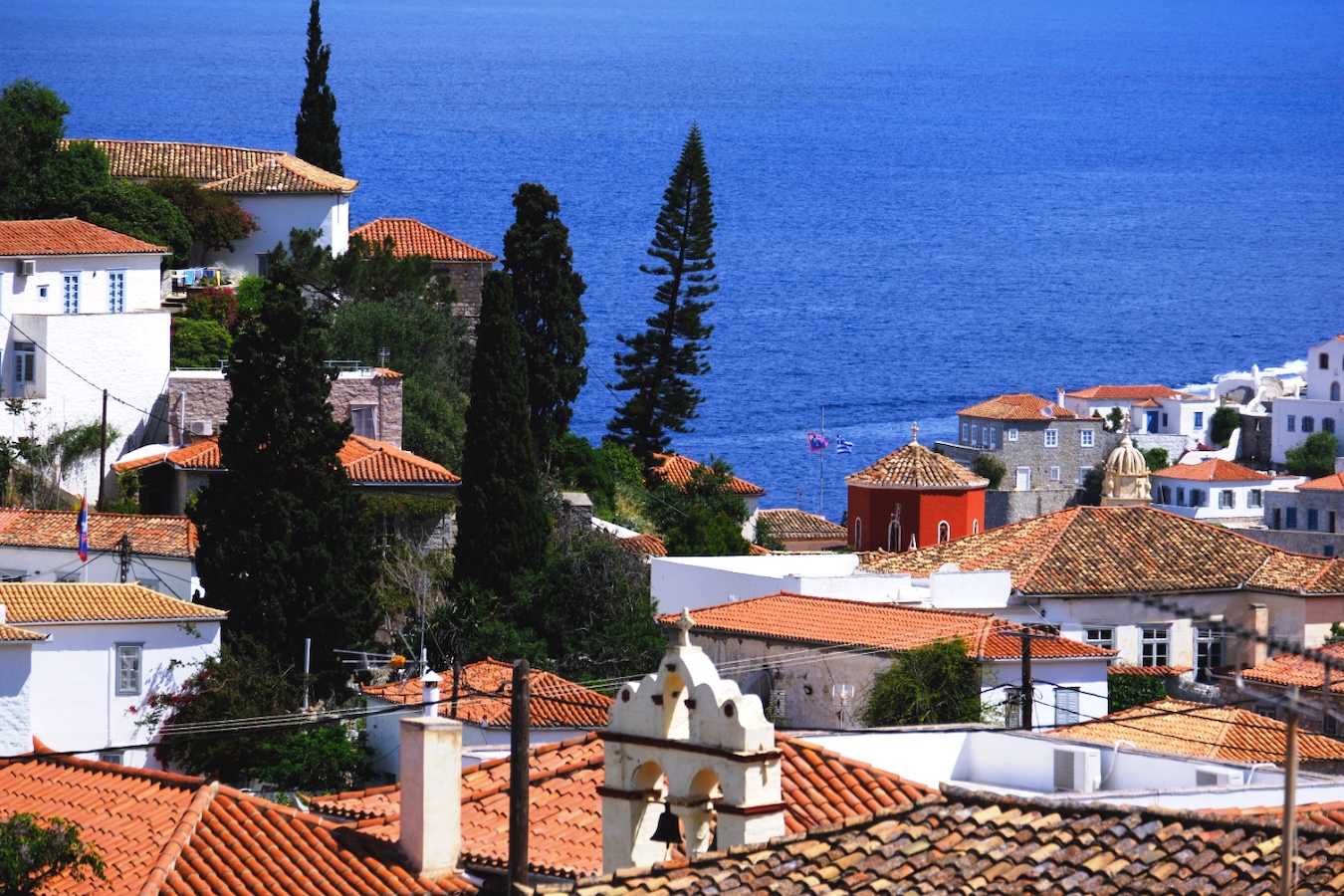
Aegina sits barely an hour from Athens, yet it feels like a different world: a grand neoclassical harbour town, hilltop temples, pistachio groves and fishing villages strung around a pine-covered coast.
It is the closest Greek island to the capital, and Athenians treat it accordingly — on summer weekends the ferries fill with swimmers and day-trippers. Stay a little longer and you’ll find much more than a quick escape.
Aegina was briefly the first capital of modern Greece, and some of the earliest coins ever minted were struck here. Today it is a working island with real orchards, real fishermen and a food culture built around its famous pistachios.
Seen from the deck of a catamaran, all of this is remarkably accessible: the island is compact, the passages are gentle, and there’s a good swim stop within minutes of almost every anchorage.
This guide covers what to see, what to do, the best beaches and swim stops, where to eat, and everything you need to plan a visit by boat.
Why visit Aegina?
Aegina lies in the heart of the Saronic Gulf, directly opposite Piraeus. That position has shaped its whole history: ancient Aegina grew rich on sea trade and minted silver “turtle” coins in the sixth century BC, among the first currency in the Western world.
The island packs an unusual amount into a small area. In a single day you can stand in a fifth-century-BC temple, wander a ruined medieval capital, swim off a deserted islet and eat dinner beside working fishing boats.
Two things make Aegina distinctive. First, the pistachios: the island’s small, intensely flavoured nuts hold protected PDO status, and you’ll find them in everything from savoury dishes to ice cream. Second, the Temple of Aphaia, which forms a so-called “sacred triangle” with the Parthenon in Athens and the temple at Cape Sounion.
Because Aegina is a living island rather than a resort, there is something happening year-round — markets, festivals, harvests — which gives even a short visit a genuine sense of place.
What to see in Aegina
The Temple of Aphaia

The Temple of Aphaia is Aegina’s headline attraction, and deservedly so.
Built around 500 BC on a pine-covered ridge above Agia Marina, it is one of the best-preserved Doric temples in Greece. Twenty-five of its original columns still stand.
The setting is half the experience. From the temple platform you can look across the gulf towards the Acropolis in one direction and Cape Sounion in the other — the alignment that gives the “sacred triangle” its name.
Come early or late in the day for the best light and cooler temperatures, and allow time for the small site museum beside the temple.
Kolona and the Archaeological Museum
Right next to Aegina Town’s harbour, the site of Kolona holds the remains of a prehistoric acropolis occupied for more than 4,000 years.
Its name comes from the single Doric column — “kolona” in Greek — that still stands beside the shore, a lonely marker of a once-important sanctuary of Apollo.
The adjoining archaeological museum displays finds from across the island, including pottery and gold from the Bronze Age. It’s a fascinating stop that takes barely an hour, and you can walk there from the yacht in minutes.
Paleochora, the abandoned capital
Inland on a rocky hill, Paleochora was Aegina’s capital from medieval times until the early nineteenth century.
The town is long gone, but the hillside is dotted with the tiny chapels its residents left behind, many still bearing faded frescoes. Climb up through the ruins and you’ll find castle walls, sweeping views over the whole island and a wonderful sense of quiet.
Go in the morning, wear decent shoes and bring water — there is little shade along the path.
The Monastery of Agios Nektarios
Below Paleochora sits the Monastery of Agios Nektarios, one of the largest monasteries in Greece and an important place of pilgrimage.
It honours a local saint who died in 1920 and was canonised for the healings attributed to him. Pilgrims still travel here from all over the Orthodox world.
Even for visitors with no religious interest, the scale of the church, the peace of the courtyards and the views down to the sea make it well worth the trip. Dress modestly — shoulders and knees covered.
Aegina Town’s old quarter

Aegina Town repays a slow wander. Behind the busy waterfront, lanes of neoclassical captains’ houses survive from the island’s brief spell as capital of Greece in the 1820s.
Look for the stone Markellos Tower, the fish market at dawn, and the small shops selling every imaginable pistachio product. Keep an eye out, too, for the ceramics studios the island is known for.
An unhurried hour here, ending with a coffee on the quay, is one of the nicest ways to start or finish a day on Aegina.
Perdika and Moni
Perdika, on the southern coast, is a postcard-perfect fishing village of low white houses gathered around a tiny harbour.
Directly offshore rises Moni, a small uninhabited islet ringed with clear turquoise shallows. Water taxis shuttle back and forth all summer, and the crossing takes just a few minutes.
Between them they make the island’s most enjoyable half-day: lunch in Perdika, an afternoon swimming on Moni, and a sunset cruise home.
What to do in Aegina
Follow the pistachio trail
Aegina’s pistachios are the island’s pride, and tasting them at the source is a genuine experience.
The trees thrive in the island’s dry climate, and the harvest in late August and September brings the whole island out into the groves. Visit a farm shop to try the nuts roasted, salted, sugared, as brittle, as pesto, even as liqueur.
If your trip falls in September, look out for the Fistiki Fest in Aegina Town, when the harbour fills with stalls, music and cooking demonstrations celebrating the nut.
Swim with the peacocks of Moni
Moni’s shallow western coves have some of the clearest water in the Saronic Gulf, and the islet itself is home to a small population of peacocks and shy wild goats.
Swim ashore, follow one of the rough paths to the chapel at the top, and enjoy the view back across the channel to Aegina. Bring water and something for shade — the pines are sparse.
Walk between the hill villages
The interior of Aegina is a quiet landscape of olive and pistachio groves, stone walls and whitewashed chapels.
A rewarding route links Kypseli, known for its pottery tradition, with Pacheia Rachi, a mountain village with a lovely old kafeneio. In spring the roadsides are full of wildflowers; in autumn the air smells of harvested pistachios.
Taxis will drop you inland and you can walk a loop back towards the coast, stopping for lunch along the way.
Take a sunset swim at Marathonas
Marathonas is the closest good beach to Aegina Town, curving around a bay that faces due west.
That orientation makes it the island’s sunset spot: arrive in the late afternoon, swim while the light turns gold, then stay for a drink at the beach bar as the sun drops behind the Peloponnesian hills.
Explore the coast by kayak or paddleboard

Morning on the Saronic Gulf is usually mirror-calm, which makes it ideal for exploring by paddleboard or kayak.
Glide along the rocky shoreline south of Aegina Town, duck into small coves accessible only from the water, and snorkel over the rocks where small fish gather. Most beaches rent equipment, and conditions suit beginners as well as confident paddlers.
Beaches and swim stops in Aegina
Aegina’s coastline mixes sandy family beaches with rocky coves, and several of the best spots are easiest to reach by boat.
Marathonas
The town-side favourite: golden sand, clear shallow water, sunbeds and a couple of relaxed bars. Ideal for an easy afternoon within sight of the harbour.
Agia Marina
On the northeastern coast below the Temple of Aphaia, Agia Marina pairs a long organised beach with a laid-back village feel. Combine a morning at the temple with an afternoon in the water.
Klima

Klima, further south, is smaller and quieter, with a handful of tavernas and a local crowd. It’s a good choice when you want a beach day without the crowds.
The coves of Moni
Boat-only and beautifully clear, Moni’s coves are the island’s signature swim. Anchor in the shallows off the western side in settled weather and enjoy one of the Gulf’s finest natural pools.
Souvala
A working village on the northern coast with a small harbour beach and a history as a thermal-spring spa town. Low-key and pleasantly unfussy.
Food and where to eat in Aegina
Aegina eats wonderfully. The island’s kitchens combine the catch of the Saronic Gulf with produce from its farms — and, everywhere, those famous pistachios.
Start with grilled octopus and a plate of fried calamari, move on to whatever fish came in that morning, and finish with something made from local nuts. These are the places we recommend.
Miltos, Aegina Town
Miltos is an institution on Aegina Town’s seafront, serving fresh fish and seafood meze to generations of locals and visitors.
Tables sit right above the water, the day’s catch is displayed on ice, and the staff happily talk you through it. Order the octopus, a Greek salad and whatever white fish looks best.
It’s popular, so book ahead in summer — or come early and enjoy a drink on the quay while you wait.
The tavernas of Perdika

Perdika’s harbour is ringed with family-run fish tavernas whose tables practically touch the water.
This is the place for a long, lazy seafood lunch: grilled whole fish, lobster with pasta when it’s available, htipiti and other meze to share. Boats tie up alongside, which tells you everything about the freshness.
Arriving by yacht? Several tavernas are happy to help arrange a short-stay berth or a tender landing — ask when you reserve.
Inland village tavernas
For a different picture of the island, eat inland. Village grill houses around Kypseli and Pacheia Rachi serve slow-cooked goat, garden vegetables and hearty stews at prices that feel like a secret.
You’ll share the room with farmers and families rather than tourists, and the drive up through the groves is part of the pleasure.
Pistachio sweets and local produce
Don’t leave without trying Aegina’s sweet side: amygdalota almond cookies, baklava made with local pistachios, pistachio ice cream and jars of pistachio brittle.
The shops along Aegina Town’s harbour sell vacuum-packed nuts that travel beautifully — the perfect provision to take back to the boat, along with local olive oil and thyme honey.
Exploring Aegina by boat
Few islands reward a private catamaran as generously as Aegina. The passages are short and comfortable, the harbours are welcoming, and the island’s best swimming is right off its shores.
For many crews, Aegina is the perfect first night of a Saronic charter: close enough to Athens for an easy arrival, interesting enough to feel like a real destination.
Arriving and berthing

Aegina Town is the main harbour, shared with frequent ferries. Visiting yachts usually berth at the western end of the quay, with water and electricity available on parts of it — confirm current arrangements with the harbour office on arrival. In July and August, aim to be tied up by mid-afternoon.
Perdika, to the south, is the romantic alternative: a compact fishing harbour where space is tight but the atmosphere is unbeatable. Fuel can be arranged by mini-tanker, and the tavernas begin a few steps from the quay.
Souvala, on the northern coast, makes a useful quieter option with a small working harbour of its own.
All three are municipal quays rather than marinas, so keep expectations realistic and always have a second choice in mind.
Anchorages and swim stops
The star attraction is Moni. In settled weather its western shallows offer a memorable daytime stop — turquoise water, sandy patches between the rocks and the islet’s peacocks calling from the pines. Watch your depth closely as you edge in, and treat it as a lunch stop rather than an overnight.
The southern coast towards Klima offers pleasant coves for a swim when northerlies blow, while the northern bays near Souvala work well in southerlies. Matching the bay to the day’s wind is the simple rule that keeps every stop comfortable.
The eastern coast is more exposed and best enjoyed as a scenic leg between stops rather than an anchorage.
Cruising tips
Summer afternoons bring a steady westerly breeze to the gulf — enough for genuinely satisfying sailing between islands, without the Cycladic drama.
Ferries come and go all day, so keep the fairways clear and expect wash near the terminals. Water and fuel are straightforward in the main harbour, though smaller quays rely on deliveries, so plan top-ups around the main ports.
Distances are delightfully short: Agistri is under an hour away, Poros an easy half-day, and the whole Saronic circuit unfolds from here. If you’re embarking in Athens, Aegina makes a relaxed opening night; if you’re finishing, it puts you perfectly positioned for the handover.
Getting around Aegina
Aegina is small and easy to explore. Local buses run from the port towards Perdika, Agia Marina and the inland villages, taxis wait by the harbour, and scooters and cars rent cheaply.
Nothing is more than about half an hour from the port, so you can comfortably combine a temple, a village lunch and an afternoon beach in a single outing.
Bicycles work well too, though the interior is hillier than it looks — e-bikes make the pistachio villages much more fun.
How many days do you need in Aegina?
One full day covers the essentials: the Temple of Aphaia in the morning, lunch in Perdika, an afternoon swim at Moni and dinner in Aegina Town.
Two days let the island open up. Add Paleochora and the monastery, a pistachio farm shop, a slow lunch in a hill village and time simply to enjoy the harbour evenings.
On a crewed charter, Aegina typically appears as either the first or last night of a Saronic loop — and both slots suit it beautifully.
Islands to visit after Aegina
Aegina sits at the centre of the friendliest island-hopping network in Greece, with four excellent next stops close by.
Agistri, less than an hour to the west, is a pine-covered gem of clear coves and quiet beaches — the Gulf’s best pure swimming stop.
Poros, to the south, offers a lively channel town, pine-fringed bays and the Lemon Forest across the water.
Hydra, eastwards, delivers the Saronics’ most spectacular arrival: a horseshoe harbour ringed by stone mansions in a strictly car-free town.
Spetses, furthest out, adds naval history, a classic-yacht old harbour and a gorgeous coastal cycle path.
Linked together, they form the classic Saronic loop — varied, sheltered and wonderfully low-stress.
Final thoughts
Aegina is often sold as a day trip, and that undersells it badly.
Give the island a proper visit and you’ll find a fifth-century temple above the sea, an abandoned hilltop capital, orchards producing Greece’s proudest pistachio, tavernas where the fish arrives with the fishermen, and water clear enough to count the pebbles beneath you.
Arrive by boat and it gets better still: short sunny passages, welcoming quays and swim stops you’ll talk about for years. Aegina may be the gateway to the Saronic Gulf — but it deserves to be a destination in its own right.
Research sources
Harbour classifications, mooring arrangements and island facts in this guide were cross-checked against the references below.
- Municipal Port Fund of Aegina — official information on the island’s ports and moorings.
- Greek National Tourism Organisation — Aegina — official destination guide.
- Hellenic Coast Guard — Port Authority Index — contacts for local port authorities.
These references support itinerary research but do not replace live navigational information, port notices or your skipper’s judgement.